Article: Gold, Gilt and Pinchbeck: What Your Jewellery Is Made Of
Gold, Gilt and Pinchbeck: What Your Jewellery Is Made Of
Gold, Gold Plated, Gold Flashed, Gold Filled, Rolled Gold, Gilt, Silver Gilt, Pinchbeck — and the Rise of Gold on Silver: What They Actually Mean
If you have ever looked at a jewellery listing and wondered what any of these words actually mean, this one is for you. Gold plated, rolled gold, gold filled, vermeil, pinchbeck. The terminology can feel deliberately confusing. It is not. It is just a lot of words that nobody ever properly explains.
Gold in Carat Form — the Real Thing
When a piece is described by its carat — 9ct, 15ct, 18ct, 22ct — that tells you it contains gold throughout. Pure gold is too soft to wear as it stands, so it is always mixed with other metals to give it strength and durability. The carat number tells you exactly how much of that mixture is gold. No coating, no base metal core, no layer that will eventually wear away.
9ct is 37.5% gold — the most common UK standard, the most affordable, and the most durable for everyday wear because the higher proportion of other metals makes it harder.
15ct is 62.5% gold. Discontinued in 1932, but you will find it constantly in Victorian and Edwardian jewellery. If you see a 15ct stamp on an antique piece, that is exactly what it is.
18ct is 75% gold. Richer colour, more gold content, softer than 9ct. The standard for a lot of fine jewellery.
22ct is 91.7% gold. Beautiful, very warm, very yellow, and quite soft. The colour is extraordinary.
Here is the thing people find counterintuitive: the higher the carat, the richer the colour, but also the softer the metal. Lower carat gold is harder and wears better. Neither is superior. They suit different things.
Carat gold will not tarnish or fade. It wears very gradually over many years, but there is no surface coating to lose. It can be resized, repaired, polished, and handed down. It is the benchmark everything else is measured against.
Gilt and Silver Gilt
Gilt is simply the old word for gold on the surface. A gilded object has had gold applied to its exterior over another material, one of the oldest decorative techniques there is.
Silver gilt means exactly what it says: silver with gold on top. At its best it is a beautiful thing. The base is sterling silver, itself a precious metal, with gold applied over it. Historically this was done by fire gilding, a technique abandoned in the nineteenth century when the mercury vapour it produced was understood to be lethal. Today the gold is applied by electroplating.
You will also see silver gilt referred to as vermeil. Vermeil is a US term with a legal definition , gold plating of at least 2.5 microns over a sterling silver base. In the UK the term carries no such regulation and can be used by anyone, for anything. The quality comes down to how thickly the gold has been applied.
Gold Plated
Gold plated jewellery has a base metal core, usually brass or copper, with a layer of real gold applied by electroplating. The gold is genuine. It is just very thin. We are talking 0.5 to 2.5 microns. A human hair is around 70 microns in diameter.
That layer will wear away. How quickly depends on the thickness, how often you wear the piece, and your own skin chemistry. The places that go first are always the high friction points, clasps, the backs of rings, the inner edges of bangles.
Gold plated jewellery is entirely legitimate and has its place. The important thing is knowing that is what you have.
Gold Flashed
Gold flashed, also called gold washed, is even thinner than gold plated, sometimes under 0.5 microns. In antique jewellery it is most commonly seen as a wash of higher carat gold over a lower carat piece, used to enrich the colour and give a deeper, more yellow tone.
Gold Filled
Gold filled is a significant step up.
Rather than electroplating a thin layer onto the surface, gold filled jewellery is made by mechanically bonding a layer of solid gold to a base metal core under heat and pressure. The gold must make up at least 5% of the item's total weight, a genuinely substantial amount compared to any plating process.
The result is durable. Gold filled pieces from the early and mid twentieth century have often survived in excellent condition precisely because the gold layer had real substance to it.
Rolled Gold
This is where it gets interesting and where a lot of people get confused.
Rolled gold is made by sandwiching a sheet of base metal between two sheets of gold, fusing the layers under heat, and rolling the whole thing out into a sheet. The jewellery is then crafted from that sheet.
This matters because the gold layer in rolled gold is dramatically thicker than anything electroplating produces, roughly 100 times thicker than standard gold plating. You can wear a rolled gold chain for a decade and it will still look gold.
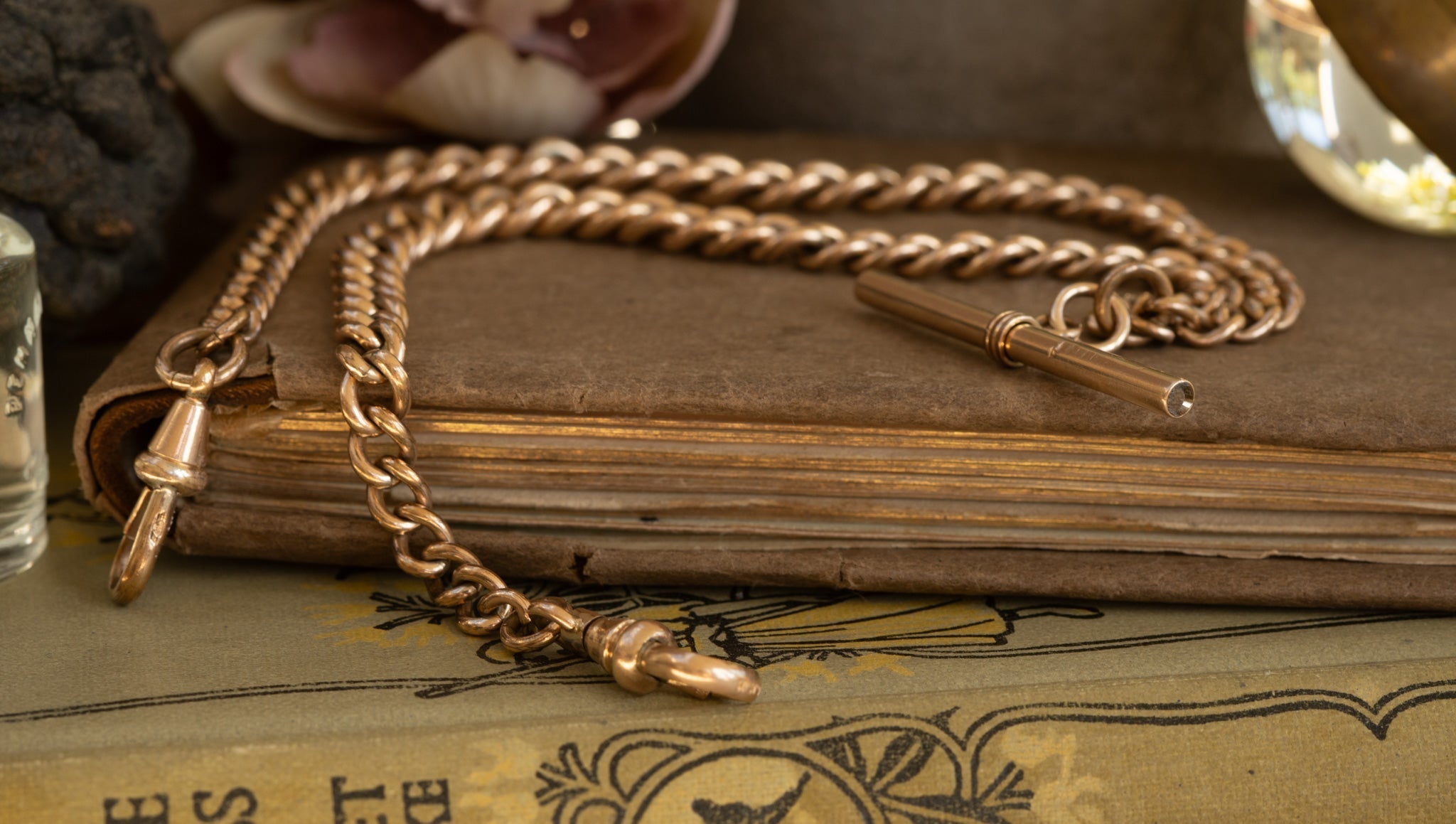
The technique was invented in the late 1700s and was enormously popular through the Victorian period. Victorian rolled gold, Albert chains, long guards, lockets, brooches, was made to a high standard and much of it has worn beautifully over more than a century. Good antique rolled gold is a genuinely desirable thing.
Rolled gold is not hallmarked in the same way as carat gold, but pieces are usually stamped with the manufacturer's mark and an indication of the gold layer. And because it is not plated, you cannot replate it in the conventional sense, if the gold layer eventually wears through, the piece would need to be electroplated. In practice, with good quality antique rolled gold, this is rarely an issue.
Pinchbeck
Pinchbeck contains zero gold. It is a copper and zinc alloy invented in the early 1700s by a London watchmaker called Christopher Pinchbeck, specifically to imitate the appearance of gold, and he did an extraordinary job of it. Well-made pinchbeck has a warm, rich, very yellow colour that is genuinely convincing.
Crucially, it was never sold as gold. It was openly available as an affordable alternative, worn by people who wanted to look fashionable without spending a fortune. No deception involved.
Because pinchbeck is a solid alloy all the way through, the colour will never wear away. There is no layer to lose. It tarnishes faster than rolled gold but polishes up easily, and because it is solid you never have to worry about damaging a surface layer.
Today pinchbeck is collectible in its own right, not as a substitute for gold but as an authentic material of its time with its own history and character. Georgian and early Victorian pinchbeck, still looking extraordinary after 150 years, deserves far more appreciation than it gets.
A Note on Gold Plating Silver
Plating silver with gold is not new. What is new is how prominently it is being marketed, driven largely by the rising price of carat gold.
The appeal makes sense. Sterling silver is a quality base metal and a gold finish over silver looks convincing and feels more substantial than gold over brass. When it is done well and described honestly, it is a legitimate product.
But in the UK there is no regulated minimum thickness for gold plating. As with vermeil, you are taking the seller's word for it.
All plating wears eventually. When the gold layer goes, the silver beneath is exposed — and silver tarnishes faster than gold. For someone who understands what they are buying, it can be a good choice. What matters is going in with clear eyes.
So What Should You Buy?
Whatever is right for you, your budget, and how you wear jewellery.
Carat gold commands a premium because it contains gold throughout and will continue to do so. Gold filled and rolled gold offer genuine quality and real longevity at a lower cost, antique rolled gold in particular is worth seeking out. Gold plated and gold flashed are honest products when sold as such. Pinchbeck is a piece of social history that deserves far more appreciation than it gets.

Leave a comment
This site is protected by hCaptcha and the hCaptcha Privacy Policy and Terms of Service apply.